
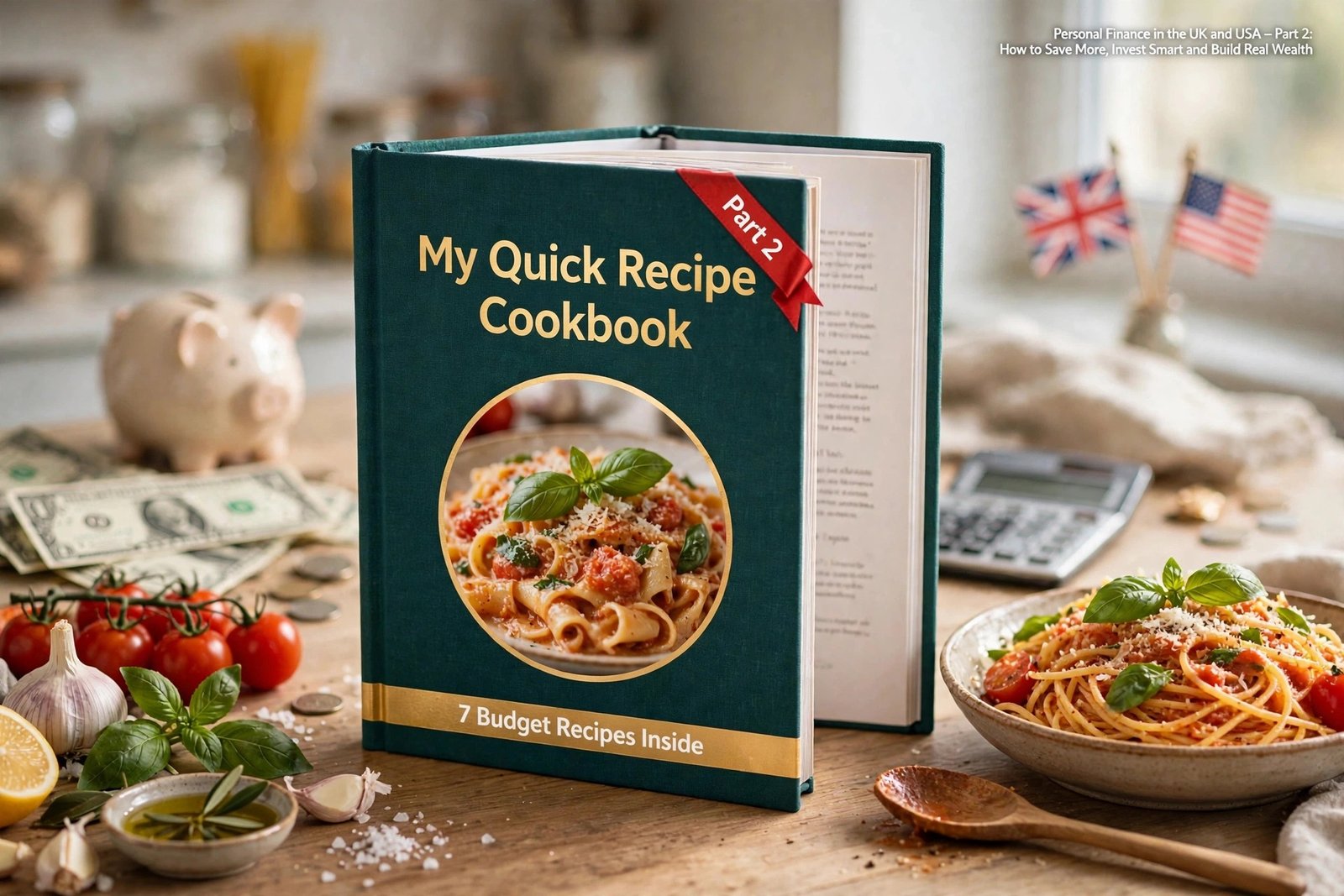
## 🔔✨ SCROLL DOWN TO GET THE FULL RECIPE COOKBOOK ✨🔔
>
Yes — a complete bonus recipe cookbook is waiting for you at the bottom of this article. Keep reading, and scroll all the way down to get it — free, no sign-up needed.
Welcome Back: What Part 2 Covers
In Part 1 of this guide to personal finance in the UK and USA, we built the foundations: a budget that works, a starter emergency fund, a plan to kill expensive debt, and the tax-smart accounts — ISAs and pensions in the UK, 401(k)s and Roth IRAs in the USA.
Part 2 is about what comes next. Once your money is organised, how do you actually move forward faster? How do you save more without living miserably, earn more without burning out, invest without gambling, and protect everything you have built?
That is exactly what this second part answers. And because food was the biggest everyday saving in Part 1, this article ends with the promised bonus: a full mini recipe cookbook of cheap, fast, family meals — the same kind of cooking that quietly saves hundreds every month. Scroll down to get the full recipe cookbook, exactly as promised at the top.
This is general financial education, not personal advice. For free impartial guidance, UK readers can use MoneyHelper and US readers can use the Consumer Financial Protection Bureau (CFPB).
The Quick Answer: Part 2 in One Page
- Save more: Automate savings on payday, raise the amount by 1% every few months, and attack your five biggest bills once a year.
- Earn more: Your income is your biggest wealth tool — one promotion, one qualification, or one small side income beats years of skipping small treats.
- Invest smart: Low-cost diversified index funds inside your ISA, pension, 401(k) or IRA — monthly, automatic, and left alone.
- Retirement: Know your number, check your UK State Pension forecast or US Social Security statement every year, and never opt out of free employer money.
- Protect it: Right insurance, an up-to-date will, strong passwords, and a hard rule — never invest in anything you found through a social media “tip”.
- Eat well for less: Cook the bonus recipes at the bottom of this article and bank the takeaway money instead.
Step 1: How to Save Money in the UK and USA — Faster, Without Misery
Most people try to save what is left at the end of the month. The problem is simple: nothing is ever left. People who save successfully reverse the order — they save first, on payday, automatically, and live on the rest.
Set up a standing order or automatic transfer for the day after payday into a separate savings account you do not see every day. Start with an amount that feels almost too easy — £50 / $50, or 5% of take-home pay. Then use the 1% rule: every three months, raise it by just 1% of your income. After two years you are saving seriously, and you barely felt any single step.
Next, do a once-a-year “big bills day”. In the UK, check energy, broadband, mobile and insurance renewal dates against Ofgem guidance and comparison tools, and never accept a renewal quote without one phone call asking for their best price. In the US, the CFPB’s guides on bank accounts and fees help you spot accounts quietly charging you for nothing. One afternoon of this routinely saves £300–£600 / $400–$800 a year — more than a year of skipping coffees.
Finally, use “no-spend windows” instead of no-spend months. Two evenings a week with no spending at all — cook from the cookbook below, walk, watch a film at home — is a habit normal people can actually keep. Saving that survives is saving that fits your real life.
Step 2: Grow Your Income — The Lever Most People Ignore
Budgeting has a limit: you cannot cut more than you spend. Income has no such ceiling. That is why how to save money in the UK and USA always, eventually, becomes how to earn more.
At your job: Keep a simple record of your results all year — sales made, money saved, problems solved — and take it into every pay review. Research the market rate for your role on salary sites before the meeting, and if your employer will not move, remember that changing jobs is statistically how most people get their largest raises. In the UK, check you are being paid at least the National Minimum or Living Wage for your age on GOV.UK; in the US, the Department of Labor publishes wage and overtime rules.
With skills: One recognised qualification, licence, or in-demand skill (a trade ticket, a coding skill, a language, a driving category) can raise your income for the next thirty years. Treat learning as an investment with the best return you will ever get — because it usually is.
With a side income: Start small and honest — selling things you no longer use, one freelance skill, weekend work you actually enjoy. Remember tax: in the UK most people have a £1,000 trading allowance before they must tell HMRC, explained on GOV.UK’s money-from-selling-things guide; in the US, side income is taxable and the IRS gig economy tax center explains what to record. Keep simple records from day one and a side income stays a pleasure, not a problem.
Step 3: Bigger Debts, Smarter — Mortgages, Rent and Cars
Part 1 dealt with expensive card and overdraft debt. Part 2 looks at the big three.
Mortgages: When a fixed deal ends in the UK, you usually roll onto a higher standard variable rate — diarise your deal’s end date six months ahead and start looking early, using the MoneyHelper mortgage guides. In the US, check whether refinancing actually saves you money after fees, not just whether the monthly payment drops, and get quotes in writing. Even 0.5% off a large mortgage is worth thousands over the term.
Rent: Renters build wealth slower only if rent eats everything. Keep rent ideally under about 30–35% of take-home pay where your city allows it, negotiate politely at renewal if you are a reliable tenant, and in the UK know your deposit protection rights through Citizens Advice — in the US, your state tenant rules are listed through the CFPB and HUD resources.
Cars: The cheapest car is usually the reliable one you already own. If you must buy, total cost matters — insurance, fuel, tax, repairs — not just the monthly finance figure. A slightly older, well-maintained car bought without expensive credit is one of the biggest quiet wealth-builders there is.
Step 4: Investing, Part 2 — From First Fund to a Real Portfolio
In Part 1 we said: invest only long-term money, only after expensive debt, and keep it simple. Here is what “simple” actually looks like in practice.
For most people in both countries, a portfolio is one or two low-cost, widely diversified index funds held inside the tax-smart wrappers — a Stocks and Shares ISA or pension in the UK, a 401(k) or Roth IRA in the US. Diversification means your money is spread across hundreds of companies and several countries, so no single company’s bad year can ruin you. The US Securities and Exchange Commission’s Investor.gov guide to diversification explains this in plain language, and the UK’s FCA investing guidance sets out the questions to ask before you invest anywhere.
Three rules protect beginners. First, time in the market beats timing the market — monthly automatic investing removes the guessing. Second, check your costs: a fund charging 0.1–0.3% a year keeps far more of your return than one charging 1.5%, and charges compound just like returns do. Third, expect falls. Markets drop 10% in ordinary years and much more in bad ones; the investors who do well are the ones whose plan already assumed this would happen. And repeat the warning from Part 1, because it matters most here: check any investment firm on FCA ScamSmart in the UK, and never act on a “guaranteed return” tip from social media or a messaging group.
Step 5: Retirement — Know Your Number
Retirement feels far away until suddenly it does not. Two checks, once a year, keep you in control.
In the UK, get your State Pension forecast on GOV.UK — it shows what you are on track to receive and whether filling any National Insurance gaps is worth it. Then read your workplace pension’s annual statement: how much went in (yours plus your employer’s), what it is worth, and what it might pay. The Pensions Regulator explains your automatic enrolment rights if anything looks wrong.
In the USA, create your account at the Social Security Administration to see your estimated benefits and earnings record — errors there are worth fixing early. Then review your 401(k): are you getting the full employer match, and are your fees low? The IRS retirement pages carry the current contribution limits each year.
A rough guide many planners use: aim to build pension and investment savings of very roughly 25 times the yearly income you want them to provide, adjusted for your state pension or Social Security. It is only a guide — but a guide you check yearly beats a surprise you meet at 65.
Step 6: Protect What You Build
Wealth is not only about growing money. It is about not losing it in one bad week.
Keep insurance boring and adequate: buildings and contents at home, car cover that meets your legal minimum and your real needs, and — if others depend on your income — life cover and income protection worth pricing properly. Make a will, or update the one you have after marriage, children, divorce, or buying a home; in the UK, MoneyHelper’s wills guide explains the basics, and in the US your state’s rules decide what happens if you die without one — which is rarely what families would choose.
Protect the digital side too: unique passwords in a password manager, two-factor authentication on email and banking, and one family rule — no money is ever moved because of an urgent message, call, or video, however real it sounds, without checking through a number you already trust. The National Cyber Security Centre (UK) and the FTC’s scam alerts (US) both publish the current tricks, free.
Your 90-Day Plan: From Part 2 to Real Progress
Days 1–30 — Automate. Payday savings transfer set, raised by your first 1%. Big bills day done. One side-income or pay-review step started.
Days 31–60 — Optimise. Mortgage or rent review booked. Pension / 401(k) checked for the full employer match and low fees. Credit reports pulled free and errors reported.
Days 61–90 — Grow and protect. ISA / Roth IRA monthly investment running (if right for you after advice and the checks above). Will written or updated. Passwords and two-factor sorted. And your kitchen running on the cookbook below at least three nights a week — the saving you can taste.
Ninety days of this will not make headlines. It will do something better: it will make your money quietly, measurably better — every single month from here on.
Frequently Asked Questions
How much can a normal family really save by cooking at home?
Replacing just three takeaways or restaurant meals a week with home cooking typically saves £150–£300 / $200–$400 a month, depending on your city and family size. The cookbook below is built for exactly that — fast meals people actually want to eat.
Should I overpay my mortgage or invest?
It depends on your mortgage rate versus expected long-term investment returns, your job security, and whether you have used your tax-free allowances. Many people split the difference. Compare your mortgage rate with the guidance on MoneyHelper or the CFPB, and consider regulated advice for large decisions.
Is it too late to start investing in my 40s or 50s?
No. You have fewer years for growth to compound, which makes starting now more important, not less — and pension tax benefits and employer contributions still apply. Focus on contributions you can sustain, low costs, and a risk level you can sleep with.
How do I know if an investment is a scam?
Three signs almost always appear: guaranteed or unusually high returns, pressure to act quickly, and contact that started on social media or a messaging app. Check the firm on FCA ScamSmart (UK) or Investor.gov (US) before any money moves — and if it is a scam, stop and report it.
What is the single best money habit from both parts of this guide?
Automation. Savings, pension contributions, and investments that happen automatically on payday survive busy months, tired months, and forgetful months. Willpower is unreliable; systems are not.
Where is the full recipe cookbook?
Directly below — you made it. Scroll just a little further and the complete bonus cookbook is yours.
🎁 YOUR FULL RECIPE COOKBOOK — THE BONUS YOU SCROLLED FOR
Thank you for reading to the end — here it is, exactly as promised at the top of this article. Seven fast, cheap, family-tested meals. Cook three or four of these a week instead of ordering in, and this cookbook alone can save you more than most budgeting apps ever will.
1. One-Pan Creamy Garlic Chicken Pasta
You need: 250g pasta, 2 chicken breasts in small pieces, 3 garlic cloves, 1 tbsp butter, 200ml cream or milk, grated cheese, salt, pepper.
Method: Boil pasta, save a cup of the water. Fry chicken in butter until golden, add garlic for 30 seconds, pour in cream and a splash of pasta water, bubble 2 minutes. Toss in pasta and cheese until glossy. Serve hot.
2. Budget Veggie Fried Rice
You need: 2 cups cooked rice (leftover is best), 2 eggs, frozen peas and carrots, 1 onion, soy sauce, oil, garlic.
Method: Scramble the eggs in hot oil and set aside. Fry onion, garlic and vegetables for 3 minutes, add rice and soy sauce, fry until slightly crispy at the edges. Stir the egg back in. Done in 10 minutes.
3. One-Pan Chicken and Rice
You need: 4 chicken thighs, 1½ cups rice, 1 onion, 3 cups chicken stock, frozen peas, paprika, salt, pepper.
Method: Brown the chicken and set aside. Fry onion in the same pan, add rice and stock, place chicken on top, cover and simmer 18–20 minutes. Stir peas through for the last 3 minutes. One pan, no fuss.
4. Hearty Lentil Soup (Cheapest Meal in This Book)
You need: 1 cup red lentils, 1 onion, 2 carrots, 2 garlic cloves, 1 tsp cumin, stock or water, oil, salt, lemon.
Method: Soften onion, carrot and garlic in oil, add lentils, cumin and 5 cups stock. Simmer 20 minutes until soft and thick. Finish with lemon juice and salt. Costs pennies per bowl.
5. Tuna Pasta Bake
You need: 300g pasta, 2 tins of tuna, 1 tin of sweetcorn, cheese sauce (or a jar), grated cheese.
Method: Cook pasta, mix with tuna, sweetcorn and sauce in an oven dish, cover with cheese, bake at 200°C / 400°F for 15–20 minutes until golden and bubbling.
6. 10-Minute Egg and Potato Skillet
You need: 3 potatoes in small cubes, 4 eggs, 1 onion, oil, paprika, salt, pepper, any leftover vegetables.
Method: Fry potatoes and onion in oil until crisp and golden, about 10 minutes. Make small wells, crack in the eggs, cover for 2–3 minutes until just set. Breakfast, lunch or dinner — all work.
7. Simple Banana Oat Pancakes (The Sweet Finish)
You need: 2 ripe bananas, 2 eggs, ½ cup oats, a pinch of cinnamon.
Method: Mash bananas, whisk in eggs and oats, rest 5 minutes. Fry small pancakes 2 minutes per side. Serve with honey or fruit. A dessert that costs almost nothing.
Cookbook tip: Plan just three dinners from this book every Sunday, shop once with a list, and put the money you would have spent on takeaways straight into your savings account the same evening. That one habit is personal finance you can eat.
Final Verdict
Part 1 organised your money. Part 2 sets it in motion: save automatically, earn deliberately, invest simply, retire knowingly, and protect everything with boring, sensible care. Add a kitchen that runs on good cheap food — your full recipe cookbook above — and how to save money in the UK and USA stops being a theory and becomes your normal week.